
Herding with your Collie
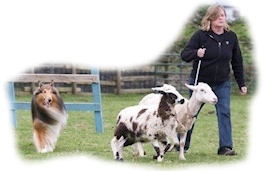 Herding with your collie can be not only fun for you, but it is extremely rewarding for your collie. The first time you step into the round pen and experience your dog's reaction to the sheep, you begin to fully appreciate what our lovely breed was created to do. Realization that the standard does take into account the structure needed to work all day can almost make the most 'head' strong breeders rethink their opinions of the collie body. "The features that make a Collie a beautiful animal in the show ring also make him a sound, agile, graceful and functional dog at work."1
If the shoulder angulation is incorrect, the dog wastes energy in movement. Same goes for the rear end. If the neck is not of sufficient length, he cannot keep his head up to locate sheep grazing in the long grasses. Correct angulation front and rear also allow for proper 'shock absorption' when herding over rough terrain. The rest of the standard is also geared around herding...semi-erect ears catch sound better than broken ones, proper tail set helps with balance, and correct coat properties help protect during all weather conditions.
There are several herding organizations Collies can compete under – CKC (Canadian Kennel Club), AKC (American Kennel Club), ASCA (Australian Shepherd Club of America) and AHBA (The American Herding Breed Association).
Under the CKC there are 2 types of herding trials. (1) The most common are Arena trials. These focus on precision, use 3-10 head of stock (usually 3 head); and all work is done in one arena. (2) Stock Dog trials that consist of a number of practical ranch chores using a minimum of 7 head of stock. These trials utilize a number of arenas, pens, fields, stock trailers, foot baths, etc.
There are also 3 types of stock used in CKC Arena trials: cattle, sheep and duck, with the most common being sheep.
CKC Herding Level Requirements
Judges determine the order of obstacles for each course. All trial levels require three qualifying legs under two judges and a core of 75 points, as well as the successful completion of each exercise. Handlers may not walk around any fenceline obstacles in these tests. ~ from an article by Donna Smith published in Dogs In Canada, May, 2002
CKC Herding Tested (non-competitive class)
Two qualifying legs are required under two judges. Sheep are in the arena where the dog must pick them up in a calm, controlled manner. Once the dog has brought the sheep to the handler, the handler can walk through each obstacle, with the dog working steadily to keep the sheep gathered as they move around the course. The dog must demonstrate a brief pause, stop or down somewhere along the way. At the end of the course, the sheep are re-penned. The judge is in the arena and may walk with the handler or stand to one side. Judges may make suggestions, but may not handle the dog. Dogs require little training but must have herding instinct to pass this test. The test is pass/fail – i.e. it is not scored.
Trial Levels
CKC Herding Started Arena
At this level, the dog must demonstrate basic skills such as calmly moving stock out of a small take-pen (at the beginning); moving stock through 3 fence-line obstacles and one free-standing obstacle; moving stock to a specific location and allowing the stock to settle; calling the dog off the stock; followed by a gather to bring the stock back to the handler; and, at the end, a hold off the exhaust pen then re-pen the stock (at the end of the course). The handler may not walk through any of the fence-line obstacles, but may walk through the free-standing obstacle. At this level the dog is working with instinct and basic commands and usually fetches the stock to the handler.
CKC Herding Intermediate Arena
Dogs must demonstrate all the skills from the Started level as well as a 50 foot walking drive followed by a 50 foot unassisted drive to the settle area; a 100 foot gather; there is a handlers line that the handler may not cross 30 feet from one of the fence-line obstacles; and the handler may not walk through any obstacles. This level is a stepping-stone level between Started and Advanced where the dog needs to do some independent work and be comfortable taking off-balance flank commands.
CKC Herding Advanced Arena
Dogs must demonstrate all the skills from Started and Intermediate as well as a 150 foot drive to a specific area with the handler remaining at a handler’s posts; a 150 foot gather; and there is a handler’s line that runs through the centre of the arena that the handler can not cross at any time without major penalty. At this level the dog must be confident enough to quickly take the handlers commands and independently work the stock at a distance from the handler.
Interested in learning more about herding? Please contact your CCC area director
or email the CCC for herding people in your area.
1 Taken from "The New Collie", Collie Club of America, Howell Book House, pg 252